Oracle Open World – PeopleSoft Perspective November 14, 2007
Posted by Duncan in PeopleSoft.comments closed
Brent Martin over at the PeopleSoft Corner Blog is putting together a daily update of the Open World conference from a PeopleSoft perspective. Pretty handy if – like me – you’re trying to keep up to date with what’s going on as it saves us all from wading through the Oracle Apps content …
Is all well with Fusion? November 14, 2007
Posted by Duncan in Fusion, Oracle, PeopleSoft.comments closed
There are rumours of hold-ups and delays within the Fusion camp.
It was only a couple of weeks ago that the ‘Head of Fusion’ John Wookey left amidst talk of a fall-out with Larry Ellison. Apparently “Oracle was trying to woo him back, though the circumstances around Wookey’s departure have not been confirmed.”
Now it appears that there is some backtracking – or at least redefining phrases from earlier statements – to allow for delays in the release. Seeing as we are only a couple of months away from the New Year, surely a release date a little more precise than between Jan 1st and Dec 31st 2008 should be possible?
It’s not as if we expect the full suite of Apps on that date. I would anticipate something more akin to the PeopleSoft Version 9.0 release, where a smallish module (was it ELM?) came out first with much fanfare about ‘Oracle meeting schedules to release PeopleSoft v9.0’, and then the main modules (HR, Financials etc) drip-fed out months later.
A Custom Message on the Signon Page (part 3) November 9, 2007
Posted by Duncan in Oracle, PeopleSoft, PIA.comments closed
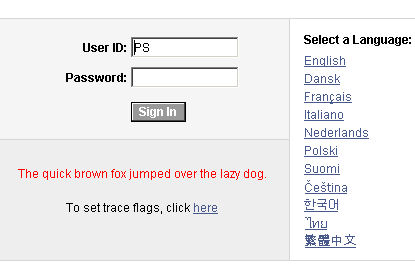
A further solution to the ‘Message of the Day’ problem has presented itself which may or may not (depending upon the client’s requirements) be a neater solution.
This is quicker and cleaner to implement, but only works with IE. If your client uses Firefox this isn’t the answer for you!
A Custom Message on the Signon Page (part 2) November 6, 2007
Posted by Duncan in Oracle, PeopleSoft, PIA.comments closed
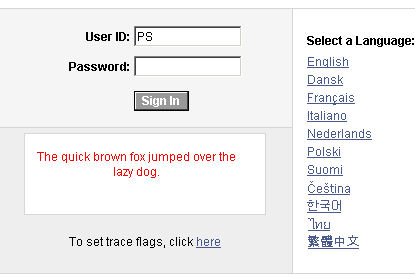
One of the criticisms that could be leveled at the previous post ‘A Custom Message on the Signon Page’ and its attempt to provide ‘Message of the Day’ functionality is that it’s static. If you need to change the message, you need to bounce the PIA. At some clients this would be fine – and at others not – so another solution was needed.
One way is to embed an iFrame in the signin.html page that points to the file containing the ‘Message of the Day’ text. The signin.html loads on PIA boot and knows it has an iFrame in it, but doesn’t look for the file until someone loads the page. Then you can change the text as often as you like without having to bounce the PIA. If the message text is longer than the box, a vertical scroll bar appears.
(This solution is better for mixed browser clients, however if you are Internet Explorer only consider this solution instead.)
A Custom Message on the Signon Page November 5, 2007
Posted by Duncan in Oracle, PeopleSoft, PIA.comments closed
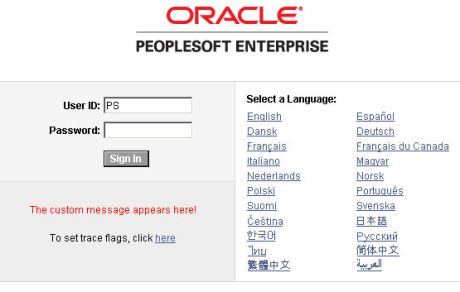
A quick and easy one today. I was asked by a colleague how to have a custom message appear on the signon page. Partly out of curiosity and partly inspired by these posts (1 and 2) I thought I’d have a look.
As the signon page is (obviously) presented before signin, it’s not going to be a ‘PeopleCode and database’ kind of solution, but I wanted something neater than just hacking the HTML each time. It turns out that it’s simpler than I feared.
XML Publisher and Out of Memory Errors October 30, 2007
Posted by Duncan in Oracle, PeopleSoft, PeopleTools, XML Publisher.comments closed
I’m getting a lot of comments on the XML Publisher posts about ‘Out of Memory’ errors. I’ve not experienced this myself so can’t give a fix or workaround, but wondered whether anyone else had hit this issue and found a resolution?
Doing a bit of digging there are a number of suggestions, none of them relate to the PeopleSoft implementation of XMLP however so I’m unconvinced by any solution in particular.
There’s a Tools patch out for this issue (8.48.06 and up contains the fix), so check your version of Tools:
http://www.peoplesoft.com/psp/portprd/CUSTOMER/CRM/c/C1C_MENU.C1_SOLN_SUMMARY.GBL?page=C1_SOLN_SUMMARY&SETID=SHARE&SOLUTION_ID=201046967
There’s a suggestion to change a parameter for XMLP (I guess this would be on the Process Defn or more likely the Process Type in PeopleSoft):
http://forums.oracle.com/forums/thread.jspa?threadID=568832&tstart=0&messageID=2116283
There’s a suggestion to create a config file (it is not delivered) to specify a temporary directory for processing large files:
http://asun.ifmo.ru/docs/XMLP/help/en_US/htmfiles/B25951_01/T421739T422152.htm
And there’s also a suggestion that a patch will fix it:
http://www.oracle.com/technology/products/xml-publisher/docs/AboutXMLP562.htm
If I was troubleshooting it and was already on 8.48.06 or greater, I’d probably try the parameter followed by the config file.
If anyone has encountered this error and fixed it, it’d be great if you posted a comment to let us know the resolution.
Fixing up PSAdmin and Services October 26, 2007
Posted by Duncan in Administration, PeopleTools, PS Admin.comments closed
I’ve just stumbled across what looks like a great new product by the Grey Sparling guys. Most (Windows) PeopleSoft DBAs and consultants who run VMs on their laptops will have been frustrated on many an occasion by the (kind of clunky) PSAdmin utility. Sure, it does what we need it to, but shouldn’t we have something better by now?
Why go for BEA? October 13, 2007
Posted by Duncan in Oracle, PeopleSoft.comments closed
It seems BEA has rejected Oracle’s approach, although that reaction didn’t save PeopleSoft from their clutches, and 13% of BEA is already owned by an Oracle friendly investor. By the sound of things Oracle has been stalking BEA for years, but why?
Are they after Weblogic (the Web Server) or Tuxedo (the middleware), or the revenue base? Does SAP use any BEA products?
I don’t know the Oracle world like I do the PeopleSoft one, but I thought Oracle usually trod the path of using open source technology with some in-house extensions for OC4J / Oracle App Server. What does Weblogic/Tuxedo offer that they don’t already have? I can understand going for PeopleSoft, Seibel etc for the strength of their HR and CRM products – amongst other things – but is this an admission that BEAs Middleware and Web Server products are superior to Oracles?
Grey Sparling also have a piece on it here.
SAP to acquire Business Objects? October 9, 2007
Posted by Duncan in Oracle, PeopleSoft.comments closed
It seems that SAP is going to acquire Business Objects, the Business Intelligence software vendor.
I wonder what this’ll mean for PeopleSoft / Oracle. Was this a response to Oracle buying Hyperion (used by many clients as a reporting solution for SAP)?
It’s also an interesting move as Business Objects owns Crystal Decisions (makers of Crystal Reports) which is of course used by some PeopleSoft clients as a reporting solution.
An Alternative way of writing Effdt clauses October 7, 2007
Posted by Duncan in Oracle, PeopleSoft, SQL.comments closed
I’ve covered the RANK analytic function before but neglected to mention a useful application for it, and that is for rewriting Effdt and Effseq clauses more efficiently.
The usual way to return the job row (this could be any table, I’m just picking job as a common example) that’s effective for each Employee at a specific date is probably something similar to this:
SELECT emplid, empl_rcd, effdt, effseq

  FROM ps_job j

 WHERE j.effdt =

    (SELECT MAX (j1.effdt)

       FROM ps_job j1

      WHERE j1.emplid = j.emplid

        AND j1.empl_rcd = j.empl_rcd

        AND j1.effdt <= '10/AUG/2007')

   AND j.effseq =

    (SELECT MAX (j2.effseq)

       FROM ps_job j2

      WHERE j2.emplid = j.emplid

        AND j2.empl_rcd = j.empl_rcd

        AND j2.effdt = j.effdt)
Execution Cost = 3010, time = 1 sec.
SELECT emplid, empl_rcd, effdt, effseq

  FROM (

SELECT emplid, empl_rcd, effdt, effseq,

  RANK () OVER

       (PARTITION BY emplid, empl_rcd

            ORDER BY effdt DESC

                   , effseq DESC) rnk

           FROM ps_job

          WHERE effdt <= '10/AUG/2007') j

 WHERE rnk = 1
Execution Cost = 665, time = 78 msecs.
Not only is the code shorter and easier, the database execution cost is less than a quarter of the ‘standard’ method and the execution time is less than a tenth.
Explain plans and costs are obviously variable depending upon your environment, the tables and indexes and the volume of data; however it should be clear from the example above that there are sometimes quicker ways than the ‘standard’ method.


 The PeopleSoft Tipster Blog