Creating an entirely read-only user in PeopleSoft August 28, 2008
Posted by Duncan in Oracle, PeopleSoft, PeopleTools, Security, SQL.comments closed
On big projects it is quite likely that large numbers of developers have access to a many environments. Occasionally they can have access to environment which is quite important, for instance one that the customer is using for training or testing.
To reduce the likelihood of developers accidentally deleting some data that they shouldn’t it would be quite normal to remove their access to the environment altogether. However if they need access for troubleshooting purposes then (at least on projects I’ve seen) it’s quite normal for developers to be told “OK, you can have access, but be careful not to do anything destructive”. Occasionally – as with everything – things can go wrong. Either someone forgets which environment they’re in, or does something with unintended consequences. An alternative to the “just be careful” approach would be to create an entirely read-only user profile (i.e. one that has display only privileges to every component system-wide).
A read-only user profile is shown in screenshot below, where no fields are editable and the save button is inactivated:
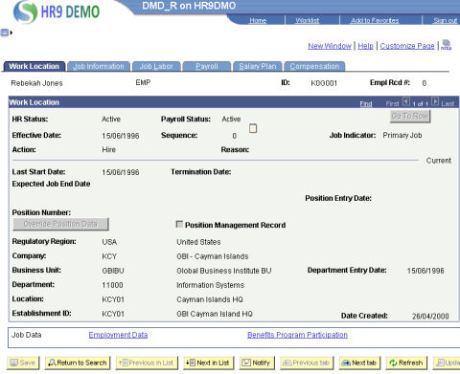
Also, on Run Control pages the ‘Run’ button is inactive. It’s going to be pretty difficult to alter data in this environment.
Here’s how to do it quickly and easily …
Substringing and Oracle SQL – Basic Trick August 18, 2008
Posted by Duncan in Oracle, SQL.comments closed
This may well be something that you already know, but it was totally new to me. It was one of those magic moments where you stumble across something so elementary you wonder:
a) how you haven’t found out about it before
b) how much time it’ll save in the future
This is related to taking only a portion of a string using Oracle SQL, and in particular the right hand side of a string. In other programming languages I’ve been spoilt with the RIGHT(x,num_chars) command, which we don’t have in Oracle.
In the past I’ve made do using something like:
SUBSTR(<character_field>,length(<character_field>)-4,4)
if I wanted to take the 4 right-most characters from a string. This gets cumbersome pretty quickly when you have multiple substrings etc.
Today – to my delight – I discovered that you can include negative numbers and Oracle will count back from the right hand side. So this will take the 4 right-most characters from a string:
SUBSTR(<character_field>,-4)
PeopleCode records: PSPCMNAME and PSPCMPROG August 11, 2008
Posted by Duncan in PeopleSoft, PeopleTools, SQL.comments closed
A widely known tip and a new (at least for me) discovery:
Widely known tip
Most techies who’ve looked under the covers will be aware of PSPCMPROG. It’s the underlying table where PeopleCode is storeed. This isn’t immediately useful however as the actual code itself is stored in the PROGTXT field in binary so it’s not easily accessible. This isn’t an insurmountable issue however as there are a couple of routines to decode the field (an SQR and a Java version, both by David L Price). I’ve not used either method personally, but a colleague has used the SQR version with great success.
For me, this field isn’t quite the most useful on PSPCMPROG. You may have noticed that if you update the PeopleCode on a record, the record properties aren’t updated to reflect the change – I guess because the record definition itself hasn’t changed (although strangely Component and Page PeopleCode do update the timestamp on the corresponding Component/Page definition – so there’s a bit of an inconsistency there). So how do you check when and by whom a piece of Record PeopleCode was last updated? If you check the LASTUPDDTTM and LASTUPDOPRID fields on the PSPCMPROG record via SQL then it’s all recorded there. This snippet of knowledge has saved me (or at least expedited troubleshooting by showing me the correct person to ask about the change) innumerable times.
Lesser known tip
I’ve not really had much reason to look at the PSPCMNAME record in the past, however a colleague and I checked it recently and discovered the RECNAME and REFNAME fields. Every time you create some PeopleCode your code is parsed and a line inserted into PSPCMNAME for every reference to a Tools object. I assume that this is the record searched when using ‘Find Definition References’ within App Designer. However, now we know the SQL table behind this we can therefore query this table to quickly find out objects affected by code in a specified project, for example.
Both the company I currently work for and my previous employer had utilities to export project details to file, printing out settings and details from Tools objects to speed-up the documentation process (and we know how much techies love documenting!). Now we can add to that utility any objects that are affected but which aren’t included in the project.
Oracle’s Fusion Progress and secrecy August 4, 2008
Posted by Duncan in Fusion, Oracle, PeopleSoft.comments closed
There’s a good summary post on Oracle and how they’re far more secretive about their products than PeopleSoft ever used to be. The post deals with Fusion, but I think that the same point applies to many products, including PeopleSoft applications and Tools releases. Even tools patches have very vague release dates.
When I posted a year or so ago that I’d heard Jesper Andersen say that the Fusion Applications suite wouldn’t GA until 2009 there was a fair bit of feedback (to put it politely – I even had to edit one comment for profanity), but now it seems more likely that Jesper was correct.
How much we read into this Gartner report is up to our own faith in Oracle, but statements like
‘Oracle plans to only sell Fusion to new customers and that “migrating the installed base to Fusion is no longer a near-term goal”.’
and
‘the 2008 Fusion applications will not include any core ERP products’
don’t fill me with confidence that we’ll see clients implementing Fusion any time soon.
It’s great news though for anyone hoping that the PeopleSoft product line remains around for a long time.
SAP to close TomorrowNow July 23, 2008
Posted by Duncan in PeopleTools.comments closed
It doesn’t feel like over three years since SAP purchased TomorrowNow, but now apparently it is to close in the next few months.
http://www.reuters.com/article/mergersNews/idUSN2140305320080721
Whilst this isn’t a huge surprise – the Oracle lawsuit over TomorrowNow’s alleged mass downloading of Customer Connection content has made the company almost unsellable and it’s continued operation prolongs the legal action handing Oracle great PR.
I’m not aware of how many customers it has here in the UK so won’t speculate as to whether we’ll see any effect.
MonkeyGrease Plea July 16, 2008
Posted by Duncan in PeopleSoft, PeopleTools, PIA.comments closed
I’m going to be looking at MonkeyGrease over the next couple of weeks and wondered if anyone felt like sharing their experiences.
I’ll be setting it up in a VM and tinkering with it to see what it can do. As a result I’d love to see screenshots, descriptions or – if you’re feeling particularly generous – some code if you’ve used MonkeyGrease in the past. I’ll give full credit to anything used, and if you do send code I won’t use it on client site, purely for the purposes of demonstrating MonkeyGrease’s functionality.
I’m aware that others have blogged about this in the past, including Jim Marion, Rich Manalang and one of the Grey Sparling team, and there is a Google Group for it. If there is anything else out there I’d love to know. Once I’ve got all the info in I’ll post a consolidated write-up and include all the links.
For those new to MonkeyGrease, see here.
Intriguing Oracle WebCast July 1, 2008
Posted by Duncan in Fusion, Oracle, PeopleSoft, Strategy.comments closed
Oracle have made available a WebCast outlining their future direction for MiddleWare strategy, and announcing what’s in store for the BEA product line.
I must admit that I haven’t listened to the WebCast myself (to be honest I didn’t think there’d be much there that affects PeopleSoft in the short term) but after reading summary posts on a couple of other blogs it seems I was wrong.
The most surprising announcement for me was that going forward
“BEA WebLogic Server is now Oracle’s strategic JEE container and will be integrated into Fusion Middleware stack immediately; OC4J dev to continue though”
This was a bit of a shock as I expected Oracle App Server to be slowly pushed as the Web Server of choice. It’s a change of tack too as in many ‘prepare now to get a headstart for Fusion’ presentations I’ve got the impression that clients should be implementing what they perceive to be Fusion middleware components now, and I’d have had Oracle App Server down as one of those applications.
Antony Reynolds also says:
“But the surprising bit was the emphasis that Thomas Kurian made on Tuxedo. It seems as though the Tuxedo guys are being rehabilitated after years in the wilderness at BEA since the WebLogic acquisition. I was amazed at the increase in connectivity and functionality that has occurred in Tux since I last came into contact with it some ten years ago.”
I’ve tried to view the webcast to find out exactly what’s behind this but can’t seem to view it. I’ll post more if I can get it working …
EDIT: Mulling this over further, I think the decision to use WebLogic over Oracle’s own product is good news for the other acquisitions. If Oracle is willing to use a product that it deigns is superior instead of just using its own product ‘because it’s Oracle’ then that bodes well for any areas of functionality within PeopleSoft, Siebel etc that may be better than corresponding areas of eBusiness suite.
VMWare Player and IP Ranges June 30, 2008
Posted by Duncan in Administration, Oracle, PeopleSoft, PeopleTools, Virtualisation.comments closed
I’ve been doing some work with VMWare Server and VMWare Player. They’re both free tools (download links can be found on the Applications page) and can be invaluable when you need a sandbox environment.
VMWare Server is great for creating the VMs, and you need it while you’re adding virtual disks etc. However once the VM is in place it may be worthwhile switching to VMWare Player. The Player is slightly faster but you can’t perform maintenance like add disks when using it. Also, they don’t co-exist on the same client machine, it’s either one or the other. To be honest, I just uninstall and install as it doesn’t take that long.
The issue I faced, and the reason for this post is that VMWare Server lets the user configure the IP Address assignments and DHCP ranges from within the application, while VMWare player doesn’t. This is a bit of an issue if you have a VM that you’ve configured with a static IP address in a non-default range, then when you switch to VMWare Player the static IP isn’t in the default range.
The secret to know is that the ability is still there, you just have to go looking for it. The utility you need is ‘vmnetcfg.exe’ and it’s under the VMWare Player install directory (i.e. ‘C:\Program Files\VMware\VMware Player’). From here you can configure the IP Ranges to be whatever you wish.
A Progress Bar for the REN Window June 25, 2008
Posted by Duncan in Application Engine, PeopleSoft, PeopleTools.comments closed
When I spoke before about the REN Server window and inserting into it, I mentioned that as well as text a progress bar was a possible inclusion.
The benefit of a progress bar to the users is that they can tell at a glance how far through a long running process is.
There are inherant problems with progress bars of course, in that they’re often less than 100% accurate. Most people have at some point joked at the time estimates for file copy progress bars within Windows, and ‘Microsoft Minutes’ is sometimes used as an ananlogy for inaccurate and super-cautious time estimates.
Despite this, I believe they have a place. For some processes – particularly those that run row-by-row – it’d be pretty easy to work out how far through it is by comparing the row number to the total number of rows.
Here’s how it’s done … (more…)
A glimpse of the future and a glance at the past June 23, 2008
Posted by Duncan in PeopleTools.comments closed
I’ve been on holiday so the posts have slowed over the last fortnight. I also don’t have any PeopleSoft tips to share, however I do have the following two observations:
Glipse of the future
I came across this amazing video in my feed reader (from Guy Kawasaki, I think).
http://www.musion.co.uk/Cisco_TelePresence.html
And all acomplished without a small R2 unit to project it …
Glance at the past
Whilst using a local cashpoint (ATM machine) from one of the UK’s largest banks the other day it appeared to hang. No amount of key pounding or patient waiting led to a returned card so I ventured inside. A member of staff kindly came to help, rummaged in the back of the machine and it rebooted. Being a tech I was of course interested to see what OS it was running, and was surprised.
Windows Embedded? Nope.
A Linux variant? Nope.
It was OS2! I’m wasn’t sure how reassured I was that part of the infrastructure of my bank runs on IBM’s creaking software but after a bit of research it appears quite common.


 The PeopleSoft Tipster Blog